

Quick answer
What Is a Sale Agreement?
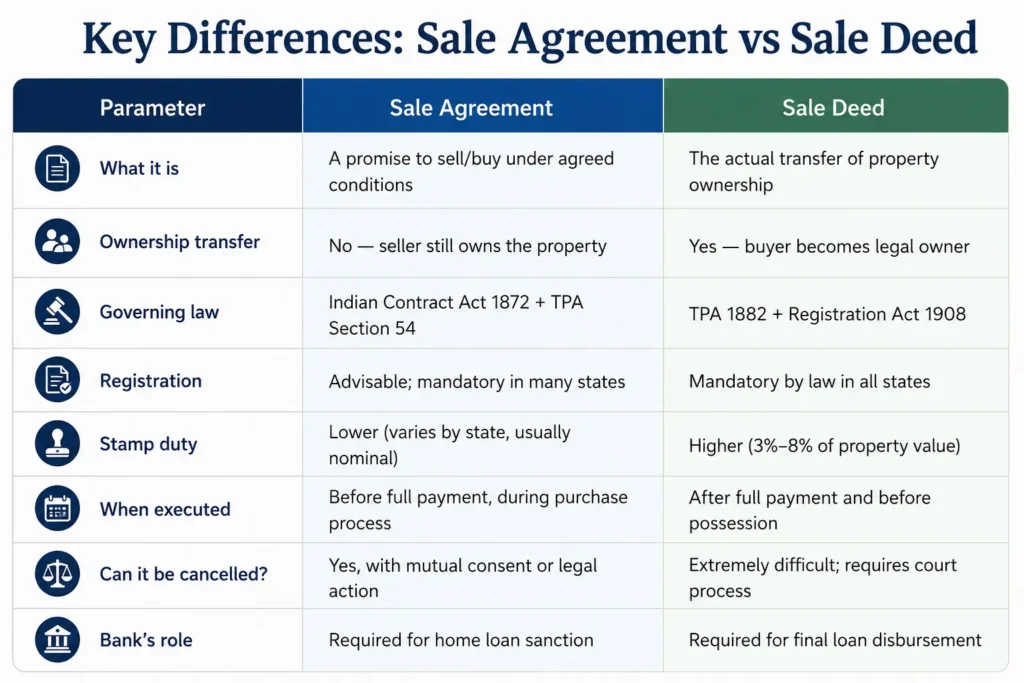
A sale agreement is a written contract between a buyer and a seller that records the terms and conditions of a property transfer. This includes the price, payment schedule and possession date. It is a promise to sell, not a transfer of ownership. The seller still owns the property after signing the sale agreement.
What Is a Sale Deed?
A sale deed is the document that actually transfers ownership of a property from the seller to the buyer. Once signed, stamped and registered at the Sub-Registrar’s office the buyer becomes the owner. Registration is mandatory by law under the Registration Act, 1908.
What Is a Sale Agreement?

A sale agreement (also called an agreement to sell or agreement of sale) is a contract between a buyer and a seller that outlines the terms and conditions under which a property will eventually be transferred. It is governed by Section 54 of the Transfer of Property Act, 1882 and the Indian Contract Act, 1872.
Think of it as a formal promise. Both parties agree on:
- The agreed-upon sale price
- The payment schedule
- The possession date
- Penalty clauses if either side defaults
- Conditions for executing the final Sale Deed
Critical point most buyers miss: A sale agreement does NOT transfer ownership. The property still legally belongs to the seller even after you sign it and pay a portion of the amount.
Under RERA (Real Estate Regulatory Authority), builders of under-construction projects are required to execute a sale agreement once a buyer pays more than 10% of the property value. This protects buyers from verbal commitments or informal booking receipts.
Is a sale agreement compulsorily registered? Under most state laws, if the agreement value exceeds ₹100, registration is advisable — and in many states, mandatory. An unregistered sale agreement has limited enforceability in court. Always insist on registration.
What Is a Sale Deed?

A sale deed is the document that actually transfers ownership of a property from the seller to the buyer. It is the final, legally conclusive document in any property transaction in India.
Under Section 54 of the Transfer of Property Act, 1882, an immovable property worth more than ₹100 can only be transferred through a registered instrument. The Registration Act, 1908 mandates that this deed be registered at the Sub-Registrar’s office of the jurisdiction where the property is located.
The sale deed includes:
- A thorough description of the property
- The buyer’s and seller’s names and details
- Payment history and total sale price
- The date of possession
- Indemnity and warranty provisions
- The state of encumbrance
Once the sale deed is registered and stamp duty is paid, legal ownership passes to the buyer. There is no ambiguity after this point — unlike with a sale agreement.
A conveyance deed is often used interchangeably with a sale deed in practice, though conveyance is a broader term covering all property transfers.
Key Differences: Sale Agreement vs Sale Deed
7 Costly Mistakes Indian Buyers Make

These are real mistakes drawn from the patterns we see repeatedly among property buyers in India. No competitor’s article covers these together.
Mistake 1: Paying Large Amounts Without a Registered Agreement
Buyers often pay 20–30% of the property value based on a verbal understanding or a simple receipt. If the sale agreement isn’t registered, your payment has no legal protection. Always insist on a registered sale agreement before making any significant payment.
Mistake 2: Assuming a Sale Agreement Gives You Ownership
Just because you’ve signed an agreement and paid a substantial amount doesn’t mean you own the property. Ownership only transfers upon execution and registration of the sale deed. Buyers have spent months in legal battles because they assumed the agreement was enough.
Mistake 3: Not Reading the Penalty Clause
Every sale agreement should include a clear penalty clause. Many standard agreements issued by builders heavily favour the builder’s side. Before you sign, you should always have a lawyer look.
Mistake 4: Ignoring the Possession Date
“We’ll give you possession in 18 months” means nothing unless it’s written in the agreement. Under RERA, buyers are entitled to compensation for delays — but only if the date is documented.
Mistake 5: Not Verifying the Property Before Signing
Always obtain an Encumbrance Certificate from the Sub-Registrar’s office before signing any agreement. This document shows the property’s transaction history for the past 13–30 years and confirms it is free of mortgages or disputes.
Mistake 6: Skipping the Sale Deed After Full Payment
Some buyers pay the full amount and then delay registering the sale deed to avoid stamp duty. This is a serious mistake. A sale deed that is not registered has no legal standing. In theory, another buyer may purchase the identical property from the seller.
Mistake 7: Trusting Possession Without a Sale Deed
Builder gives you keys and says “we’ll do the paperwork later”? This is a red flag. Possession without a registered sale deed does not make you the legal owner. Always get the sale deed registered before or at the time of taking possession.
What If the Seller Backs Out? Know Your Legal Rights
Here’s what the law actually says and it’s much stronger than most people realise.
The Specific Relief Act, 1963 is your primary protection. A buyer can file a suit for Specific Performance a court order compelling the seller to execute the sale deed. The court can force the seller to complete the transaction, not just pay compensation.
In 2018, the Specific Relief (Amendment) Act made specific performance the default remedy instead of a discretionary one. Before 2018, courts could simply award compensation. After 2018, specific performance is the rule — making the sale agreement far more powerful.
If the seller backs out, your options are:
- Specific Performance Suit — Court compels seller to execute the sale deed. Now the default remedy post-2018 amendment.
- Earnest Money Refund with Damages — Sue for return of the advance paid plus compensation.
- RERA Complaint — If your seller is RERA-registered, file a complaint with the state RERA authority.
The strength of your case depends almost entirely on whether your sale agreement was registered.
(Source: Specific Relief (Amendment) Act, 2018 — Ministry of Law and Justice — indiacode.nic.in)
Stamp Duty on Agreement vs Deed: State-wise Table
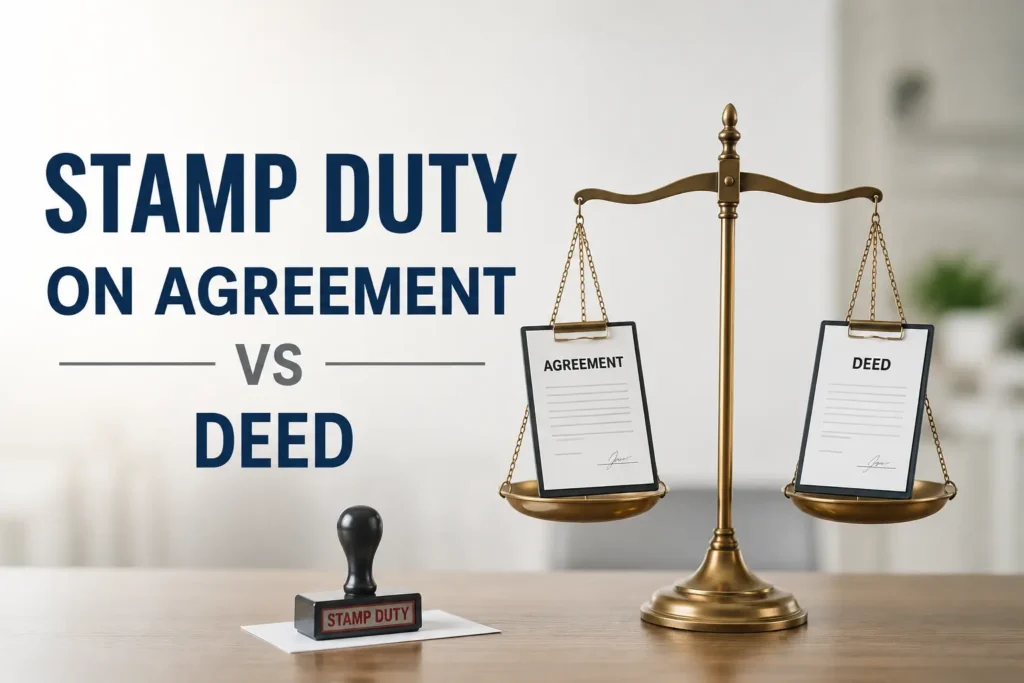
Note :Stamp duty rates are subject to change by state governments. Always verify with your state’s stamp duty authority before executing any document. Figures below are indicative based on currently available government sources
| State | Stamp Duty on Sale Agreement | Stamp Duty on Sale Deed | Registration Charges |
| Karnataka | ₹20 flat (nominal) | 2%–5% (slab-based on property value) | 2% of property value (revised from 1%, effective 31 Aug 2025) |
| Maharashtra | 0.1% of Agr. Value | 5% (men); 4% (women) in municipal areas. Mumbai: 6% total (5% + 1% metro cess for men) | 1% of property value, max ₹30,000 |
| Tamil Nadu | ₹20 flat | 7% of market value | 4% of market value |
| Delhi / NCR | 2% of Agr. Value | 6% (men); 4% (women); 5% (joint) | 1% of property value |
| Telangana | 0.5%of Agr. Value | 4% stamp duty + 1.5% transfer duty = 5.5% total (urban/Hyderabad) | 0.5% of property value |
| Uttar Pradesh | 2% of Agr. Value | 6%–7% depending on property value | 1% of property value |
Key takeaway: In most states, stamp duty on a sale agreement is significantly lower than on a sale deed — because it does not transfer ownership. Delaying the sale deed registration to avoid stamp duty is illegal and risky.
For Karnataka-specific details, see our guide: Complete Checklist Before Buying an Apartment in Bangalore 2026
Verified Source |
Vault PropTech — Karnataka Stamp Duty Guide 2026 (vaultproptech.com) |
Financial Calculator — Maharashtra Stamp Duty 2026 (financialcalculator.io) |
NoBroker — Tamil Nadu Stamp Duty 2026 (nobroker.in) |
DLF Delhi Stamp Duty Guide 2026 (dlf.in) |
Tricolour Properties — Telangana Stamp Duty 2026 (tricolour.co.in) |
ClearTax — UP Stamp Duty 2026 (cleartax.in) |
Home Loan Approval: Which Document Does Your Bank Actually Need?
The answer: Both, but at different stages.
Stage 1: Loan Sanction → Bank Needs the Sale Agreement
When you apply for a home loan for an under-construction property, your bank will require the registered sale agreement, RERA registration certificate, builder’s approval documents, and your KYC and income proof. Based on these, the bank sanctions your loan in principle.
Stage 2: Full Disbursement → Bank Needs the Sale Deed
The final disbursement — the last tranche — is typically held back until the sale deed is registered in the buyer’s name. Delaying the sale deed means EMI payments begin without receiving the full loan amount.
For the full home loan process, read: Home Loan Process in Bangalore: Step-by-Step Guide for First-Time Buyers
How to Verify Both Documents Online
India has made it possible for buyers to verify property documents online, state by state.
- Karnataka (Bangalore, Mysuru): Kaveri Online Services: Look up sale agreements, registered sale deeds, and encumbrance certificates
- Tamil Nadu (Chennai, Coimbatore): TNREGINET — registered documents, EC, and guideline values
- Maharashtra (Mumbai, Pune): IGR Maharashtra — document search, stamp duty calculation, EC verification
- Delhi and NCR: Delhi Registration Department — registered document search and stamp duty details
- Telangana (Hyderabad): IGRS Telangana — EC and registered document search
- Uttar Pradesh (Noida, Lucknow): IGRSUP — property and document search, stamp duty payment
Always cross-reference an Encumbrance Certificate from the Sub-Registrar’s office with what the seller tells you. Prior to signing any contract, this cannot be negotiated.
Final Thoughts
Understanding the difference between a sale agreement vs sale deed is not optional for property buyers in India it is essential. The agreement is the beginning of the journey; the deed is the destination. Neither can be skipped, delayed, or taken lightly.
If you’re looking at properties in Bangalore and want to understand how this translates into your specific purchase decision, Buloke’s team of real estate specialists is here to walk you through every step.
FAQ
Is a sale agreement enough to own a property?
No. Legal ownership only transfers when the sale deed is registered in your name at the Sub-Registrar’s office.
Can I live in a property with only a sale agreement?
You may get physical possession, but you don’t legally own the property. Your ownership claim remains vulnerable to disputes without a registered sale deed.
What if the sale deed is not registered?
An unregistered sale deed has no legal standing. Under Section 49 of the Registration Act, 1908, it cannot be used as evidence of property transfer.
Which comes first — sale agreement or sale deed?
The sale agreement always comes first. Once all conditions are fulfilled and full payment is made, the sale deed is executed and registered.
Can a sale agreement be cancelled?
Yes, with mutual consent or through a court order. The aggrieved party can seek cancellation plus compensation, or pursue specific performance under the Specific Relief Act.
What is token money in a sale agreement?
Yes, with mutual consent or through a court order. The aggrieved party can seek cancellation plus compensation, or pursue specific performance under the Specific Relief Act.
Can the seller sell the property to someone else after signing a sale agreement with me?
Technically yes, since legal ownership hasn’t transferred. But doing so after a registered agreement would be fraudulent and gives you strong legal protection under the Specific Relief Act, 1963.
