
Can NRIs buy property in Bangalore in 2026? Yes. NRIs can legally buy residential and commercial properties in Bangalore without prior RBI approval, provided they comply with FEMA regulations and use approved banking channels. Bangalore remains one of India’s most attractive real estate markets for NRIs due to strong rental demand, ongoing infrastructure development, and long-term appreciation potential. This guide explains the eligibility rules, required documents, home loan options, tax implications, legal checks, and common mistakes NRIs should know before purchasing property in Bangalore.
Bangalore remains the top choice for NRIs buying property in Bangalore and for good reason.. Strong rental demand, steady price appreciation, and an IT-driven economy make it a city that consistently delivers returns.
But buying property from abroad comes with its own set of rules. What you can purchase, how you transfer funds, what taxes you owe all of it is governed by a framework most NRIs have never had to navigate before. This guide walks you through every step
NRIs Buying Property in Bangalore: Is It Legal and What Are the Limits?
The short answer is yes. As an NRI, you are fully allowed to buy property in Bangalore under the Foreign Exchange Management Act (FEMA). The RBI has already granted general permission no special approval needed before you purchase.
You can buy residential apartments, houses, and commercial properties. What you cannot touch is agricultural land, plantation property, or farmhouses anywhere in India, no exceptions. If a seller promises RBI approval for restricted land “later,” that is your cue to walk away.
NRIs Buying Property Rules India 2026: What Matters Right Now

Under NRI property buying rules India 2026, the buying process has become more streamlined, but fund compliance is monitored far more closely than before.
According to the Reserve Bank of India’s FEMA guidelines (rbi.org.in), every rupee used for your purchase must come through legitimate banking channels. You can use funds from your NRE (Nonresident External), FCNR (Foreign Currency Non-Resident), or NRO (Non-Resident Ordinary) accounts but never cash or informal transfers.
As per the Income Tax Department’s guidelines for FY 2025-26, TDS on property transactions involving NRI buyers is now tracked through Form 26QB with tighter scrutiny. Keeping a clean paper trail from day one protects you at every stage purchase, rental, and eventual sale.
Choosing Where to Buy in Bangalore
Bangalore’s residential market has seen sustained demand. According to the Knight Frank India 2024 report (knightfrank.com/research), Bangalore ranked among the top three Indian cities for residential property demand driven in part by NRI investment interest.
The right location depends on your goal.
If rental income is the priority, Electronic City, Whitefield, and Marathahalli have deep demand from IT professionals. Vacancy rates are low and rental yields are relatively stable.
If long-term appreciation is the goal, North Bangalore Yelahanka, Hebbal, and Devanahalli near the international airport has shown consistent price growth over the past three years. IVC Road in this belt is also seeing increasing developer interest, with infrastructure catching up fast. Read more on IVC Road Bangalore real estate insights if this corridor interests you.
If lifestyle and liveability matter most, South Bangalore neighborhoods like JP Nagar, Bannerghatta Road, and Jayanagar offer established schools, hospitals, and social infrastructure ideal if you plan to eventually return and live there.
Ready-to-Move vs Under Construction: What NRIs Buying Property in Bangalore Must Know
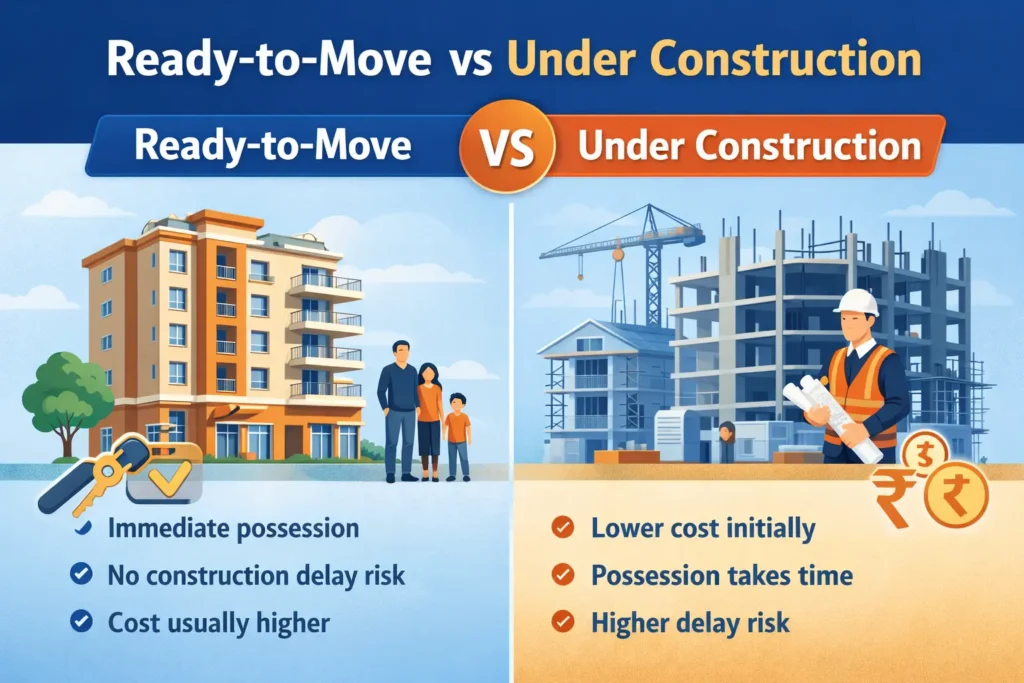
This is a decision that carries more weight when you’re buying remotely.
A ready-to-move apartment gives you certainty. you see what you’re buying, there’s no construction risk, and rental income can start immediately after registration. The trade off is a higher price.
An under-construction project is priced lower at launch and typically appreciates by possession. But delays are common, and as an NRI you won’t be there to monitor progress. This makes the builder’s reputation critical. Before paying any booking amount, verify their past project deliveries, legal cclearances, and RERA registration status.
For a full breakdown of how these two options compare on cost, risk, and return, read Ready to Move vs Under Construction Homes in Bangalore.
Documents You Need as an NRI Buyer
From your side: valid passport, visa or OCI/PIO card, PAN card, overseas address proof, and your NRE/NRO/FCNR bank account details. PAN is non-negotiable no property transaction in India can proceed without it.
From the seller or builder: sale deed, Encumbrance Certificate (confirming no legal dues), Khata certificate from BBMP, approved building plan, and the RERA registration number.
If you can’t be present in India for registration, a Power of Attorney (POA) allows a trusted family member or lawyer to sign and register on your behalf. The POA must be notarized and apostilled in your country of residence a step many NRIs overlook until it’s too late.
For a step-by-step verification checklist covering every document and approval you should confirm before signing, refer to Checklist Before Buying an Apartment in Bangalore 2026.
How to Transfer Money From Abroad
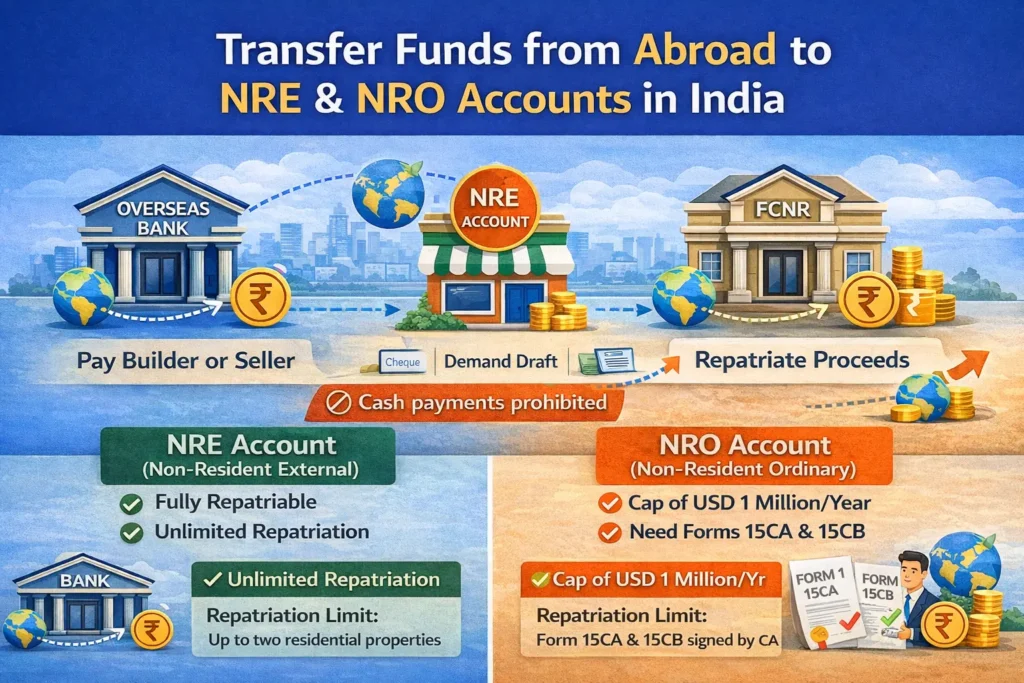
Transfer funds from your overseas bank to your NRE or FCNR account in India. From there, pay the builder or seller by cheque, demand draft, or bank transfer. Cash payments are prohibited and can jeopardise your ability to repatriate proceeds later.
The NRE account is fully repatriable when you sell the property, you can send the money back to your foreign account without any restrictions (up to two residential properties). This makes it the preferred route for most NRI buyers.
If you use an NRO account instead, repatriation is allowed but capped at USD 1 million per financial year. You’ll also need Form 15CA and Form 15CB, signed by a Chartered Accountant, to be submitted to your bank before the transfer.
Taxes NRIs Pay When Buying Property in Bangalore
Stamp Duty and Registration
Properties above ₹45 lakh attract 5% stamp duty plus 1% registration charges. Between ₹21 lakh and ₹45 lakh, it is 3%. NRIs pay the same rates as resident Indians no separate slab exists.
TDS When Buying
If the property crosses ₹50 lakh and the seller is a resident Indian, you deduct 1% TDS before payment and deposit it via Form 26QB on the Income Tax Portal. Most assume the seller handles this — the deduction is actually the buyer’s job.
Capital Gains When You Sell
Hold for more than two years and Long Term Capital Gain tax applies at 12.5% as per Finance Act 2024. Sell earlier and your income tax slab rate kicks in. The buyer will deduct 20% TDS upfront at the time of sale you can claim a refund later when filing your Indian ITR, so plan your cashflow accordingly.
Getting a Home Loan in India as an NRI
Most major Indian banks SBI, HDFC, ICICI, Axis Bank offer home loans to NRIs, typically up to 80% of the property value. Interest rates generally range between 8.5% and 10.5% depending on the lender and your profile.
You’ll need foreign income proof: recent salary slips, employment letter, and six months of bank statements. If these are not in English, they may need notarised translation. Repayments must come from your NRE or NRO account not from a foreign bank account directly. Setting up auto-debit from your NRE account keeps everything FEMA-compliant and avoids missed EMIs. For a complete walkthrough of the loan application process, read the Home Loan Process in Bangalore 2026 Guide.
Common Mistakes NRIs Make When Buying Property in Bangalore
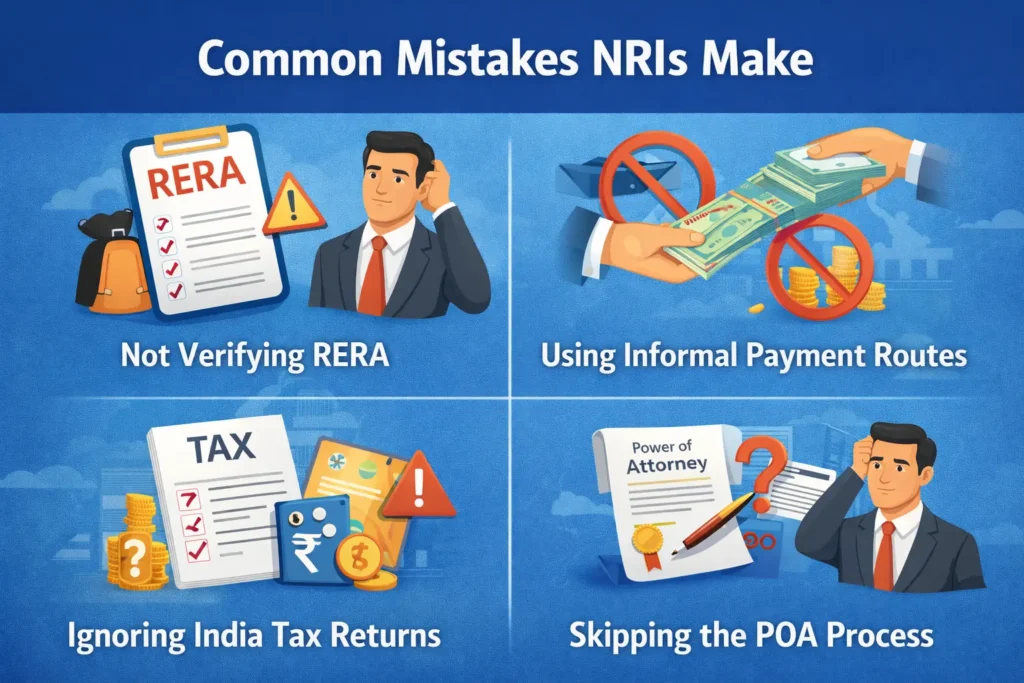
Not verifying RERA — Every project must be registered with RERA Karnataka before you pay even a token. Check at rera.karnataka.gov.in. Unregistered projects offer no legal protection.
Using informal payment routes — Any undocumented transfer creates a compliance gap that blocks repatriation and complicates your tax filing.
Ignoring India tax returns — If you earn rental income or make a capital gain from Indian property, you must file an ITR in India, even if the net tax is zero.
Skipping the POA process — An invalid POA can void your registration entirely. Get it properly notarised and apostilled before the deal moves forward.
Final Thoughts
NRIs buying property in Bangalore today have better tools, more regulatory protection, and clearer processes than ever before. RERA has changed the accountability landscape. Banking has simplified. The city’s fundamentals remain strong.
Go in informed, keep your money trail documented, choose a RERA-registered project, and work with a lawyer who understands NRI transactions. Bangalore has room for you make sure the property you buy there is worth coming back to.
FAQ
Can NRIs buy property in Bangalore?
Yes. NRIs can legally buy residential and commercial property in Bangalore without any special RBI approval under FEMA guidelines. However, agricultural land, plantation property, and farmhouses are not permitted anywhere in India.
Which bank account should NRIs use to buy property in Bangalore?
NRIs should use their NRE or FCNR account to buy property in Bangalore. NRE accounts are fully repatriable meaning you can send sale proceeds back abroad without restrictions. NRO accounts can also be used but repatriation is capped at USD 1 million per financial year.
What is the stamp duty for NRIs buying property in Bangalore in 2026?
NRIs pay the same stamp duty as resident Indians. Properties above ₹45 lakh attract 5% stamp duty plus 1% registration charges. Properties between ₹21 lakh and ₹45 lakh attract 3% stamp duty. No separate NRI slab exists.
What documents do NRIs need to buy property in Bangalore?
NRIs need a valid passport, OCI or PIO card, PAN card, overseas address proof, and NRE/NRO/FCNR bank account details. From the seller collect the sale deed, Encumbrance Certificate, Khata certificate, approved building plan, and RERA registration number. PAN card is mandatory without it no transaction proceeds.
Can NRIs buy property in Bangalore without visiting India?
Yes. NRIs buying property in Bangalore can complete the entire purchase without visiting India by executing a Power of Attorney in favour of a trusted family member or lawyer. The POA must be notarised and apostilled in the NRI’s country of residence before registration.
What tax do NRIs pay when selling property in Bangalore?
If the property is held for more than two years Long Term Capital Gains tax applies at 12.5% as per Finance Act 2024. For properties sold within two years the applicable income tax slab rate is charged. The buyer deducts 20% TDS at the time of sale which the NRI can claim as a refund when filing their Indian Income Tax Return.
Which areas in Bangalore are best for NRI property investment in 2026?
For rental income Electronic City, Whitefield, and Marathahalli offer strong demand from IT professionals. For long term appreciation North Bangalore including Yelahanka, Hebbal, Devanahalli, and IVC Road has shown consistent price growth. For liveability and eventual self use South Bangalore neighbourhoods like JP Nagar, Jayanagar, and Bannerghatta Road are the most established choices for NRIs buying property in Bangalore.
