

Carpet area is the actual usable space inside your flat — the area you physically live in — while built-up area adds wall thickness and balcony, and super built-up area further includes your proportionate share of common spaces like lobbies, lifts, and gyms.
In a typical apartment, the super built-up area quoted by a builder can be 25% to 45% larger than the carpet area. That means on a flat advertised as 1,200 sq ft, your actual livable space could be as little as 780–850 sq ft. Under RERA (2016), builders across India are legally required to disclose and price flats based on carpet area only making it the only number that truly matters when comparing homes.
This guide breaks down all three terms with real numbers, a side-by-side comparison, and a simple formula to calculate the loading factor yourself — so you know exactly what you’re paying for before signing anything.
What Is a Carpet Area in a Flat?
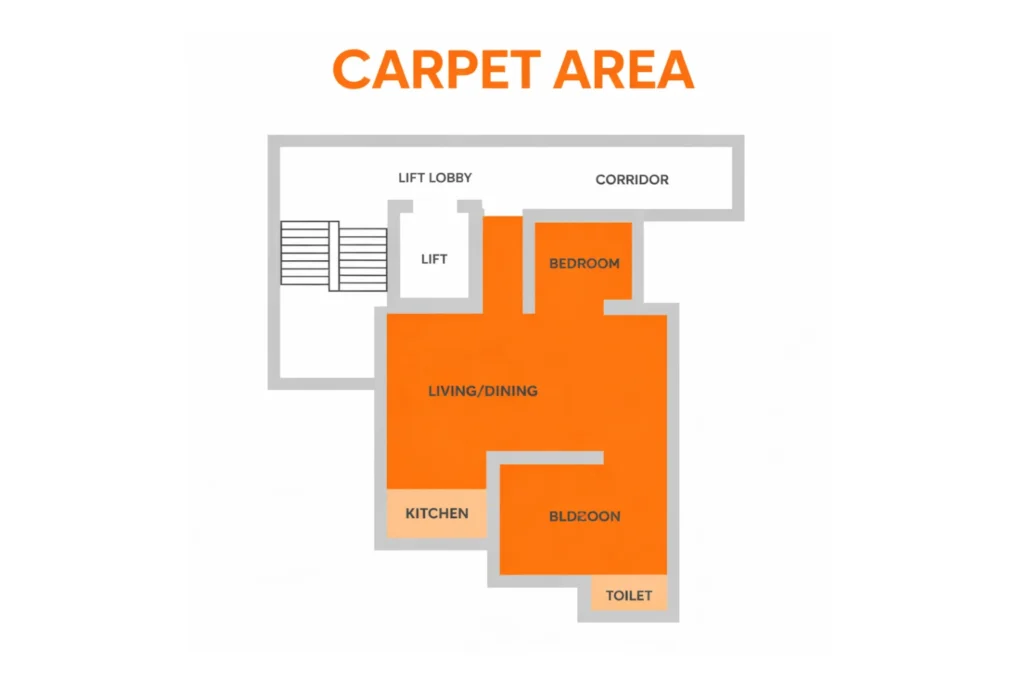
Think of it this way. Lay a carpet on the floor of your home. Every square foot that carpet covers? That ‘s your carpet area .
In simple terms, carpet area is the actual usable area inside your flat — the space where you put your furniture, cook food, sleep, and live your daily life. It includes all the rooms, the kitchen, bathrooms, and internal corridors. But it does NOT include the thickness of the walls.
The Real Estate (Regulation and Development) Act, 2016 — better known as RERA — has a clear legal definition for this. According to RERA Karnataka, carpet area is the net usable floor area of an apartment , excluding the area covered by external walls, service shafts, exclusive balconies, verandahs, and open terraces.
This was a game-changer for homebuyers. Before RERA came in, builders could quote any number and there was no standard definition to challenge it. Now, by law, every builder must clearly disclose the carpet area of every flat they sell.
Carpet area is the only number that truly reflects your daily living experience.
What Is Built-Up Area?
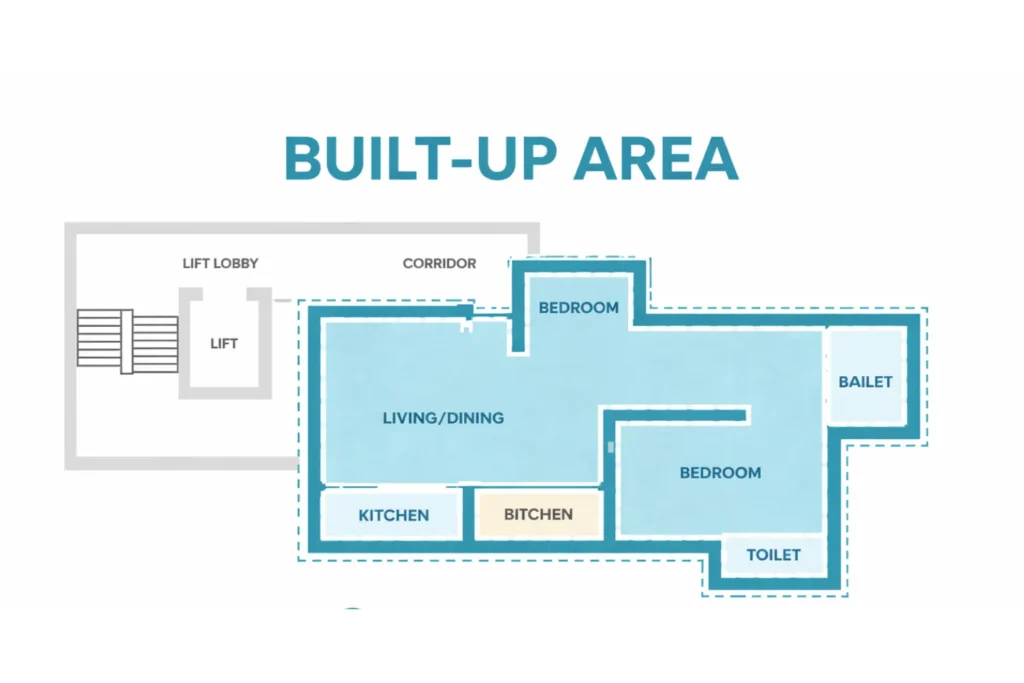
Built -up area is one step bigger than the carpet area. It adds the thickness of the walls both inner and outer along with any balconies or utility spaces attached to your flat.
A simple way to remember it :
Built-Up Area = Carpet Area + Thickness of Walls + Balcony
Typically, the build-up area runs about 10% to 15% more than the carpet area. So if your carpet area is 800 sq ft, the built-up area would be roughly 880 to 920 sq ft.
Before anything else, it also helps to evaluate the builder ‘s credibility. A trustworthy builder will always be transparent about these numbers from day one. Our guide on how to check builder reputation in Bangalore walks you through exactly what to look for.
What Is Super Built-Up Area?
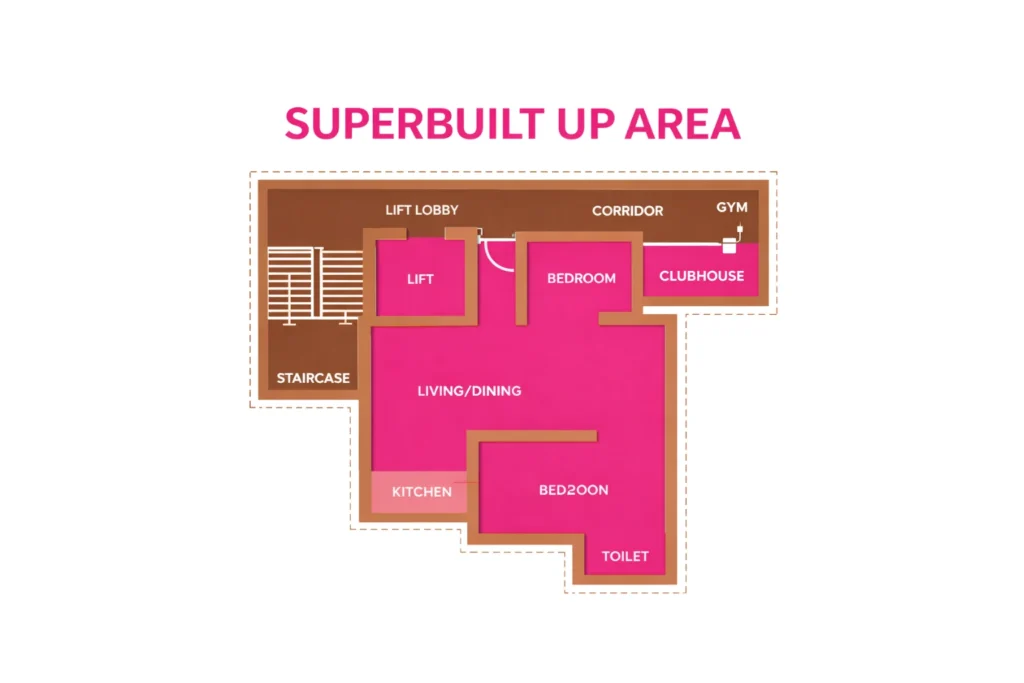
Now that you understand both individually, let’s see how carpet area vs built up area actually plays out in real numbers when a builder quotes you a price.This is where it gets tricky — and where most buyers feel short- changed later.
Super built-up area, also called saleable area, includes your flat’s built-up area plus your proportionate share of all the common spaces in the building. The lobby where you walk in every morning, the staircases,the lift shaft, the gym , the clubhouse, the security cabin — all of these cost money to build. Builders recover that cost by adding your share of those spaces to the “size” they quote for your flat.
Super Built-Up Area = Built-Up Area + Proportionate Share of Common Areas
The ratio between super built -up area and carpet area is call ed the load ing factor. In many Indian metros, this loading ranges between 25% to 45%.
That’s a significant gap. If a builder quotes you a 1,200 sq ft flat based on a super built-up area, your actual livable carpet area might only be around 780 to 850 sq ft.
According to NoBroke r’s Real Estate Report 2023, in cities like Mumbai and Bengaluru, loading factors in premium projects frequently cross 35% — meaning buyers pay for considerably more than what they physically live in (source: NoBroker Real Estate Report 2023).
Carpet Area vs Built-Up Area vs Super Built-Up Area — Side by Side
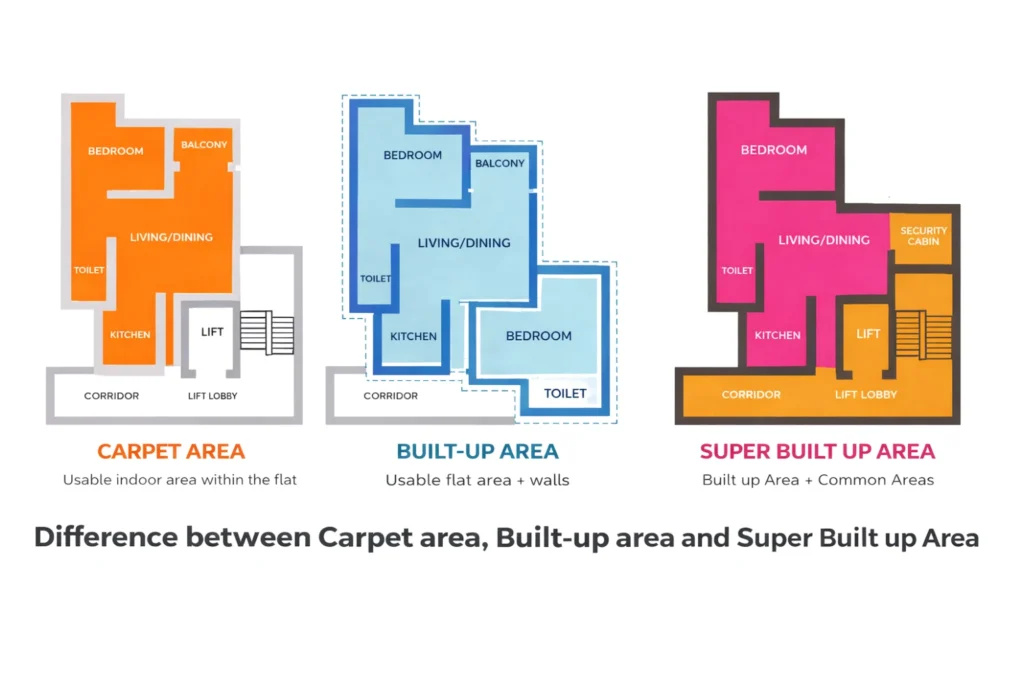
To make carpet area vs built up area vs super built up area easy to visualise, here’s a simple side by side breakdown Let’s put it all together here with one clear example.
Say a flat has a carpet area of 900 sq ft. The built-up area would be approximately 1,000 to 1,050 sq ft after adding walls and balcony. The super built-up area quoted by the builder could be 1,200 to 1,300 sq ft after common area loading. But you are living in and using only 900 sq ft every single day.
| Area Type | What It Includes | Approx. Size (Example) |
| Carpet Area | Usable living space only | 900 sq ft |
| Built-Up Area | Carpet area + walls + balcony | 1,000–1,050 sq ft |
| Super Built-Up Area | Built-up area + share of common spaces | 1,200–1,300 sq ft |
This is not fraud — it is a standard industry practice. But it becomes a real problem when buyers compare flats purely on the super built-up area number without digging deeper.
Why RERA Made Carpet Area the Only Standard
Before RERA came into effect in 2016, there was no uniform measurement standard across India. Builders in different cities used different yardsticks. Some quoted super built- up areas as the flat size . Some used built-up area. Very few led with carpet area.
RERA changed that entirely. Under RERA, all builders must now price and advertise flats based on carpet area only. They must register their projects and disclose all measurements transparently.
Always cross-check any project’s RERA registration before you commit. Our complete guide on RERA approved projects in Bangalore shows you how to verify this on the Karnataka RERA portal in just a few minutes.
How to Calculate the Loading Percentage Yourself
You don’t need to rely on the builder’s word. Here’s a simple calculation you can do on your own:
Loading % = ((Super Built-Up Area – Carpet Area) / Super Built-Up Area) × 100
So if the super built-up area is 1,200 sq ft and the carpet area is 840 sq ft:
Loading = ((1,200 – 840) / 1,200) × 100 = 30%
That means 30% of your purchase price is going toward common areas — not your personal living space.
Is 30% reasonable? It depends entirely on what the project offers. A building with a rooftop pool, a grand entrance lobby, multiple lifts, and landscaped gardens will naturally carry higher loading. A straightforward mid-segment residential building should have noticeably lower loading. Anything above 40% deserves a serious conversation with the builder before you sign anything.
Common Mistakes Homebuyers Make

The most frequent mistake is comparing two flats purely on super built-up area. A 1,200 sq ft flat in one project and a 1,200 sq ft flat in another can have dramatically different carpet areas — because every project carries its own loading factor.
Always ask for the carpet area in writing. Then verify it on the RERA Karnataka portal. This takes five minutes and eliminates a lot of confusion later.
Another mistake buyers often make is focusing entirely on area while overlooking everything else — construction quality, legal clearances, location trade-offs, and project timelines. Area is important, but it’s only one piece of the puzzle. Before signing anything, go through our checklist before buying an apartment in Bangalore 2026 to make sure you haven’t missed anything critical.
Final Thoughts
Understanding Carpet Area vs Built Up Area vs super built-up area is not about being suspicious of builders. It’s about knowing exactly what you’re paying for.
To put it as simply as possible — the carpet area is your home. Everything else is extra.
Next time a builder shows you a brochure, look for the carpet area first. If it isn’t clearly mentioned, ask for it. Under RERA, they are legally required to disclose it. Then run the loading calculation yourself. It will tell you more about a project’s real value than any sales pitch ever could.
Planning to buy in Bangalore? Explore more homebuying guides and project insights at Buloke.
