
If you’re buying a flat in Bangalore, you’ll run into three documents that sound similar but do completely different jobs, and mixing them up is an expensive mistake to make. This guide breaks down OC vs Khata vs Completion Certificate in plain language, so you know exactly what to ask for before you sign anything.
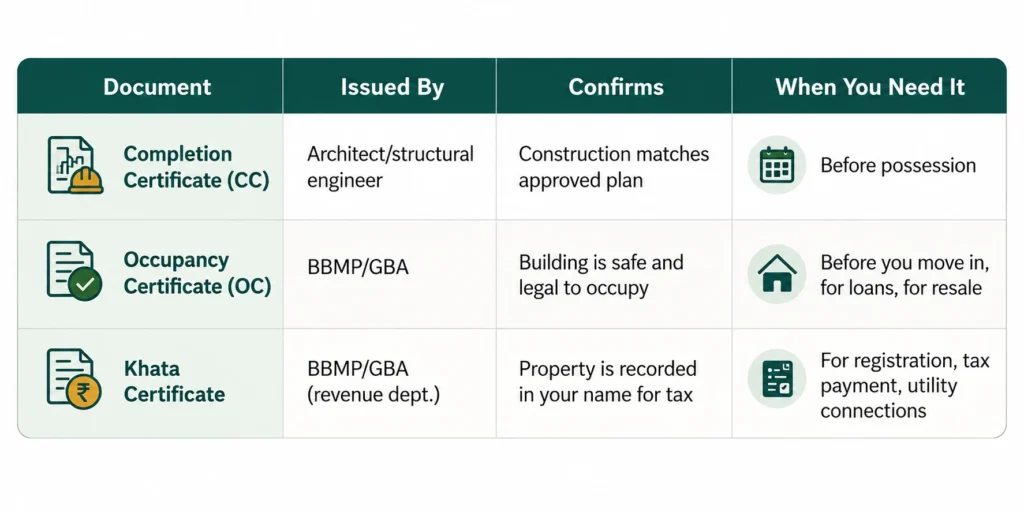
- Completion Certificate (CC): issued by the builder’s architect, confirms construction matches the approved plan. It comes first.
- Occupancy Certificate (OC): issued by BBMP/GBA, confirms the building is safe and legal to live in. Needed for loans, utilities and resale.
- Khata Certificate: a tax and revenue record from BBMP/GBA, needed for registration and property tax. Comes as A Khata or B Khata.
- None of the three replaces another. A clean Khata or a CC doesn’t mean the OC exists.
- Before you sign anything, ask for the CC, the OC status, and the Khata type in writing.
What Is an Occupancy Certificate (OC)?
The OC is issued after construction wraps up and the building passes inspection for fire safety, structural stability and compliance with the sanctioned plan. Without it, the property is technically not fit to occupy, no matter how finished it looks.
In practice, the gap between construction finishing and the OC actually arriving can run anywhere from a few months to a few years, depending on how quickly the builder applies and how clean the construction is against the sanctioned plan. During that gap, buyers often get possession of the flat but not the OC itself, which is exactly where problems start.
Under the Real Estate (Regulation and Development) Act, 2016, Section 11(4)(b), developers are legally required to hand over the OC to buyers (source: taxguru.in). This isn’t optional paperwork. It’s the single document banks, utility providers and future buyers will ask for first, and without it your home loan’s final disbursement can get held up even after you’ve moved in.
If you want the full walkthrough on getting or checking your OC, including how the 2026 GBA rule change affects things, we’ve covered that separately.
What Is a Khata Certificate?
Khata is a revenue record maintained by the municipal authority (BBMP or GBA) that shows a property exists in their tax records under your name. It’s what allows you to pay property tax and get utility connections in your name, and it’s what your sub-registrar will ask for at the time of registration.
It comes in two types, A Khata and B Khata, and the difference between them matters a lot when you’re buying, since one of them means the property is fully compliant and the other means there’s pending regularisation. We’ve covered that full distinction, along with how to convert one to the other, in our Khata certificate guide. The part that matters for this comparison: Khata has nothing to do with whether a building is legally safe to live in. That’s the OC’s job, not Khata’s. A property can have a clean Khata and still be missing its OC, and buyers often assume one guarantees the other when it doesn’t.
What Is a Completion Certificate (CC)?
The CC is the earliest of the three. It’s issued by the architect or structural engineer once physical construction is done, confirming the building matches the approved plan. Think of it as the builder’s own sign-off before the authority steps in to verify things independently and issue the OC.
The CC is a self-certification by the project’s own architect, not an inspection by the municipal authority. That’s the whole reason the OC exists as a separate step: it’s the government’s independent check on top of the builder’s own claim. Many builders hand over possession right after the CC, before the OC comes through, and treat the two as interchangeable when they’re not. That gap is where most buyer complaints start, and it can stretch on for years if the builder never gets around to applying for the OC at all.
OC vs Khata vs Completion Certificate: Key Differences
Here’s the full OC vs Khata vs Completion Certificate comparison side by side, so you can see at a glance who issues each document and when you actually need it.
A Real Example: What Happens When a Buyer Skips This Check
Say a buyer takes possession of a flat because the builder shows them a CC and calls it “as good as done.” Two years later, they try to sell the flat, and the new buyer’s bank asks for the OC before releasing the loan. It doesn’t exist. Now the seller is stuck negotiating a lower price, chasing the original builder for a document that should have been sorted before possession, or in some cases waiting on a pending OC application that’s been sitting with the authority for months. None of this shows up as a problem on the day you move in. It shows up the day you try to sell, refinance, or get a fresh utility connection, which is exactly when you have the least leverage to fix it.
Common Mistakes Buyers Make With These Documents
A few patterns show up again and again with Bangalore flat buyers, and most of them come down to assuming one document proves something it doesn’t.
Assuming CC means the flat is ready and legal
The CC only confirms construction is done. It says nothing about whether the building passed the government’s own safety and compliance check. Buyers who treat the CC as the finish line often find out the OC never followed.
Assuming a clean Khata means the building is legally sound
Khata is a tax record, not a safety certificate. A property can be fully in your name for tax purposes and still be missing its OC, which means it’s not actually legal to occupy.
Trusting verbal assurances instead of getting a written timeline
“The OC is coming soon” is not a document. If a builder can’t give you a written timeline with a specific date, that’s a signal the application may not even be filed yet.
Not checking documents until registration day
By the time you’re at the sub-registrar’s office, you’ve usually already paid most of the money. Ask for the CC, OC status, and Khata type before you sign the agreement, not after.
Do You Need All Three to Buy a Flat in Bangalore?
Yes. Skipping any one of them creates a real problem later, not a paperwork technicality.
- No CC: the OC application itself gets stuck, since CC is usually a prerequisite.
- No OC: banks can refuse home loans, BESCOM and BWSSB can refuse permanent power and water connections, and resale becomes difficult since the next buyer’s lender will ask the same question you should be asking now.
- No Khata (or stuck on B Khata): you can’t get the property registered cleanly in your name, and property tax payment gets complicated.
Note that the recent OC exemption in Karnataka is scoped to small individual residential houses on plots up to 2,400 sq ft (G+3 floors) within GBA limits, not apartment complexes bought from a builder. Large apartment complexes and multi-storey buildings still require an OC as before (sources: Ujjivan Small Finance Bank, Cyril Amarchand Mangaldas). If you’re buying a flat, the OC is still mandatory for you regardless of that exemption. We’ve broken down exactly who the exemption does and doesn’t cover in our OC exemption guide.
Quick Checklist Before You Buy
- Ask for the CC and OC copies directly, don’t rely on the sales brochure.
- Confirm whether the property is on A Khata or B Khata.
- Check the OC status online before final payment. Our occupancy certificate guide shows the exact steps.
- If buying resale, ask the seller for the original OC copy, not a photocopy.
- Never treat “possession given” as proof the OC exists. Builders can, and do, hand over keys before the OC comes through.
- Get any missing-document promise in writing, with a date, before you sign.
FAQ
Is Khata the same as OC?
No. Khata is a tax and revenue record. OC certifies the building is safe to occupy. A property can have one without the other.
Can I get a home loan without an OC?
Most banks require the OC before final loan disbursement, since it’s proof the building is legally habitable.
Is a B Khata property risky to buy?
It’s not automatically risky, but it usually means pending regularisation. Get clarity on what’s pending and a written timeline for conversion before buying. Full conversion steps are in our Khata certificate guide.
Which document should I check first before signing an agreement?
Start with the CC and OC. Khata matters at registration stage, but the OC affects loan approval and legal occupancy, which come earlier in the buying process.
Getting clear on OC vs Khata vs Completion Certificate before you sign anything is one of the simplest ways to avoid a legal headache later, and it costs you nothing but a few questions to the builder.
For more on choosing the right project or checking builder credibility before you commit, browse our full guides on buloke.com.
