

This RBI repo rate home loan EMI 2026 update covers what changed and what it means for your monthly payment.
Following a year of rate reductions, the RBI maintained the repo rate at 5.25% during its June 2026 meeting.Took a home loan linked to the repo rate? You should already be paying less than you were in early 2025, somewhere between ₹3,000 and ₹5,800 less a month on a ₹50 to 75 lakh loan. EMI hasn’t budged at all? Your loan is probably still sitting on an older MCLR benchmark, and it’s worth a quick check with your bank. The next RBI meeting is scheduled for August 3–5, 2026.
The RBI Repo Rate: What Is It?
Picture the RBI as the bank that other banks borrow from. When SBI, HDFC, or ICICI need short term cash, that’s where they go, and the interest they pay on it is called the repo rate.
Why should you care? Cheaper money for banks usually means cheaper loans for you. When the repo rate drops, banks’ own borrowing costs drop, and some of that gets passed down to you through lower home loan rates. When the repo rate climbs, it can work the other way, and your EMI creeps up.
whenever you spot a headline about RBI cutting or holding rates, it’s really about one thing, whether your loan just got cheaper, pricier, or stayed exactly where it was.
RBI Repo Rate Cuts in 2025 to 2026: A Quick Timeline
Here’s what actually went down, straight from RBI’s own policy record:
- The easing cycle began in February 2025, when rates were lowered from a peak of 6.50%.
- Four rate reductions were made through 2025, bringing the total reduction to 125 basis points.
- Feb and April 2026: RBI hit pause, holding at 5.25% for the first time in over a year.
- June 2026: another hold at 5.25%, unanimous this time, with rising inflation flagged as a real concern. The central bank raised its inflation forecast for FY27 to 5.1% from an earlier 4.6%, and trimmed its growth forecast to 6.6% from 6.9%, citing crude oil prices and the West Asia conflict as the main pressures (Forbes India coverage of the June 2026 MPC meeting).
So yes, the cutting phase looks done for now. RBI’s clearly in wait-and-watch mode.
How Does the RBI Repo Rate Actually Affect Your Home Loan EMI?
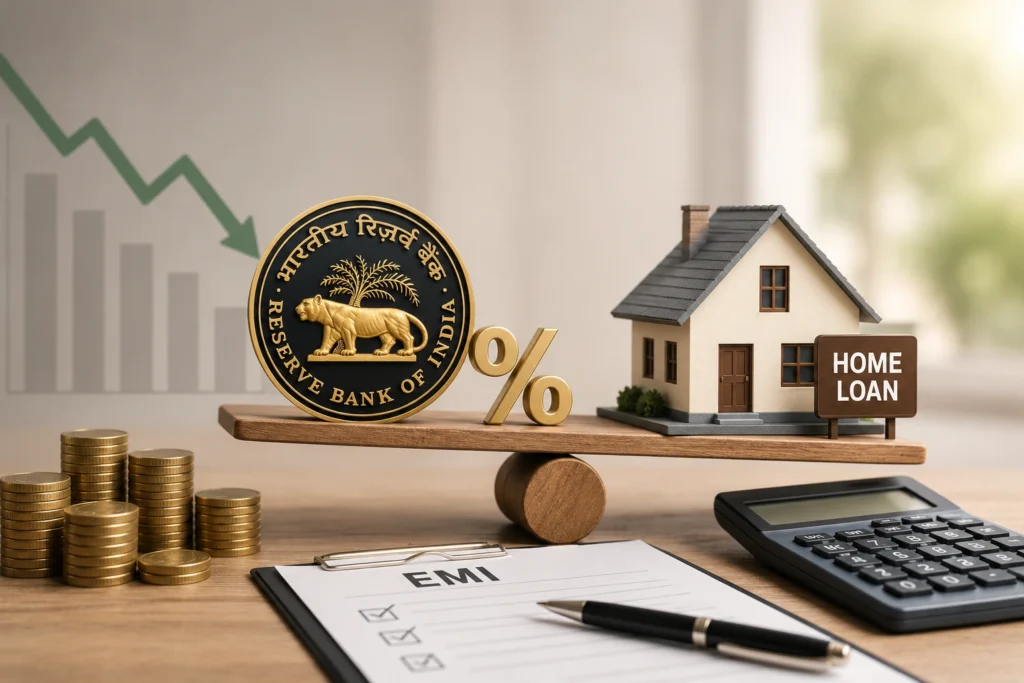
The RBI repo rate home loan EMI 2026 connection comes down to one thing, what your loan is linked to.Two systems are in play here.
EBLR (External Benchmark Lending Rate): Since October 2019, every new floating rate home loan from a bank must be linked to an external benchmark, usually the repo rate itself. Your rate is simply Repo Rate plus the bank’s spread. Banks are required to reset this at least once every three months, so if the RBI cuts rates, you should feel it within 90 days.
MCLR (Marginal Cost of Funds based Lending Rate): This is an older, internal benchmark that banks calculate based on their own cost of funds. It does not move in step with the repo rate. When RBI cuts rates, MCLR eventually comes down too, but often with a lag of several months.
If you took your loan before October 2019, there is a real chance you are still on MCLR, or even the older Base Rate system, and are not getting the full benefit of the cuts already delivered. If you are still at the stage of applying for a loan and want to understand how the process works end to end, our home loan process guide for Bangalore buyers walks through it step by step.
Fixed Rate vs Floating Rate: Which Makes Sense Right Now?
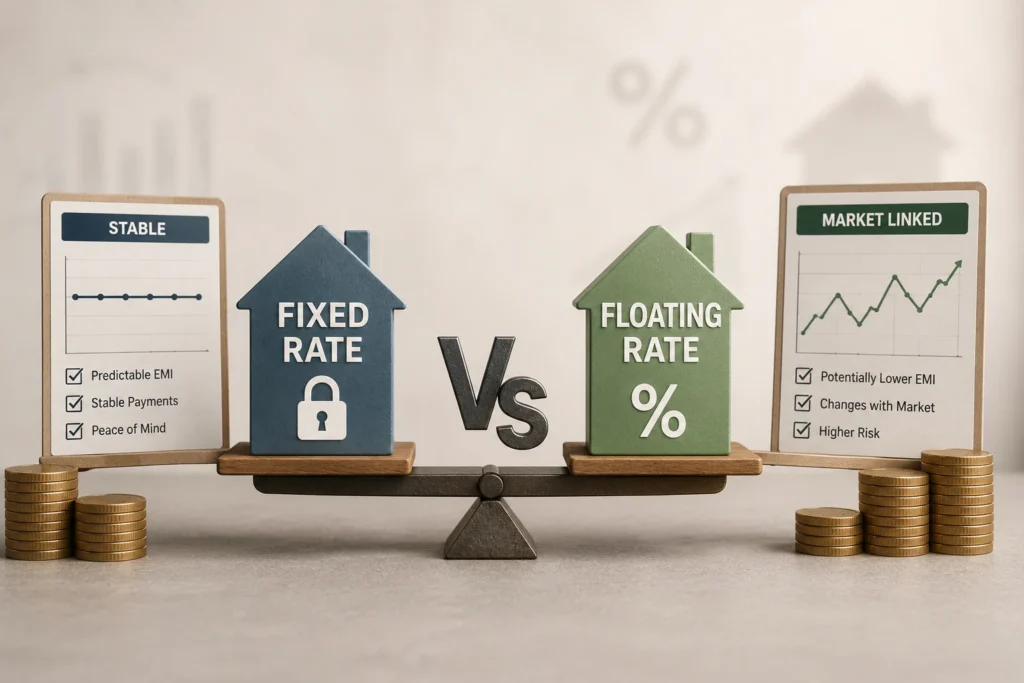
Once you get how repo rate and EMI connect, the next natural question is whether to go fixed or floating. A fixed rate loan locks your EMI for the agreed period, and as of early 2026, banks were starting fixed rates around 9.50% or higher, well above floating rates at the time. You get predictability, sure, but you’d miss out on any future cuts, and you wouldn’t have caught the benefit of the 2025 cuts either.
A floating rate loan linked to EBLR moves with the repo rate, which is exactly why it has been the better choice through this cutting cycle. The trade off is that if the RBI ever reverses course and starts hiking, your EMI would move up too. Given the RBI’s current neutral stance and the emphasis on caution rather than aggressive action in either direction, most existing floating rate borrowers are unlikely to see a sudden increase in the near term.
Are You Actually Saving? Three Things to Check
Before you assume your EMI reflects the current rate, here’s a quick RBI repo rate home loan EMI 2026 checklist worth running through.
- When did you take the loan, and on which benchmark? If it predates October 2019, ask your bank directly whether you are on MCLR or EBLR.
- When did your EMI last change? On a repo linked loan, a full 125 basis point cut since early 2025 should translate to a meaningful drop. According to a BankBazaar analysis reported by Business Today, a borrower with a ₹50 lakh, 20 year loan should see an EMI saving of roughly ₹3,050 a month and a lifetime interest saving of about ₹7.34 lakh. On a ₹75 lakh loan, the saving works out to around ₹5,800 a month, or close to ₹13.94 lakh over the loan’s life.
- What is your current effective rate? As of April 2026, SBI’s EBLR worked out to Repo Rate (5.25%) plus a spread of 2.65%, landing at 7.90%, according to Upstox’s home loan rate tracker, with the final rate to you depending on your credit score. If your rate is noticeably higher than this, ask your bank why, or consider a balance transfer.
If your EMI has not moved at all since 2025, it is worth having that conversation with your lender this month, not waiting for the next rate change.
What Happens Next: RBI's August 2026 Meeting
RBI’s Monetary Policy Committee is back at it on 3 to 5 August 2026 (source:Cleartax). Most market watchers are betting on another hold, given the neutral stance and the inflation worries flagged in June, but nothing’s off the table, rates could still move either way depending on monsoon, oil prices, and how the West Asia situation plays out. Either way, it’s a date worth marking if you’re deciding whether to lock in a loan now or wait it out.
Is 2026 a Good Time to Buy a Home in Bangalore?

Rates are down 125 basis points from their 2025 peak and holding steady rather than climbing, so affordability is in decent shape right now, with no sign of rates ticking back up. We’ve covered this question in more depth in Is 2026 the Right Time to Buy Property in Bangalore, which looks at pricing trends alongside this same rate environment.
One more thing worth checking before you finalise anything: if the apartment you’re eyeing is closer to completion, look into the OC exemption rules in Karnataka, since occupancy status affects both loan disbursement and resale value later on.
Final Thoughts
The rate-cutting phase of 2025 delivered real savings, and the June 2026 hold means those savings are staying put for now rather than disappearing. If your EMI hasn’t moved despite all this, that’s not something to ignore, it’s worth a call to your bank this month rather than waiting around. And if you’re on the buying side rather than the borrowing side, this is a fairly stable window to make a decision in, rates aren’t climbing, and the next real signal comes only with the August 2026 meeting.
Explore more listings and city guides on the Buloke blog, or head to the Buloke homepage to browse current residential options across Bangalore.
FAQ
What is the current RBI repo rate in 2026?
As part of the RBI repo rate home loan EMI 2026 picture, the rate stands at 5.25%. It’s been unchanged since April 2026, confirmed again at the June meeting.
Will my home loan EMI go down automatically after an RBI rate cut?
Depends on your loan. EBLR linked loans move with the repo rate on their own, MCLR and fixed rate loans don’t, and MCLR tends to lag by several months even when it does adjust.
How much can I save on a home loan after the 2025 to 26 rate cuts?
Rough numbers, a ₹50 lakh loan over 20 years works out to around ₹3,050 less a month, and a ₹75 lakh loan closer to ₹5,800 less, compared to what you’d have paid at early 2025 rates.
When is the next RBI policy decision?
3 to 5 August 2026, RBI’s first meeting since the June hold. Most analysts expect another pause, though that could shift depending on oil prices and monsoon progress.
Is it a good time to buy a home in Bangalore right now?
Rates are down 125 basis points and holding steady, so borrowing is cheaper than most of 2023 and 2024. Still worth comparing lenders and double-checking your loan’s benchmark before signing anything.
Note: The rates, numbers, and dates listed here are correct as of publication and could change depending on future RBI policy decisions and specific loan arrangements. This is not financial advice; it is merely basic information. Before deciding whether to borrow money or refinance, please speak with your bank or a qualified financial advisor.
