

Quick Answer: An occupancy certificate (OC) in Bangalore is an official document issued by BBMP or GBA certifying that a building is legally safe to live in. Without OC, occupying a flat is illegal under the Karnataka Municipal Corporations Act and RERA 2016. Builders must obtain OC before handing over possession. No OC = no legal right to occupy, no A Khata, and potential bank loan rejection.
You’ve paid the booking amount. The builder has sent a possession letter. Your family is excited. And then someone asks: “Did you check the OC?”
Most buyers in Bangalore have no answer to that question not because they’re careless, but because nobody told them it mattered. The occupancy certificate in Bangalore is not just another document in a pile of paperwork. It is the one certificate that makes your home legally yours to live in. Without it, you are technically occupying an unauthorised structure, regardless of how much you paid or how reputed the builder is.
This guide covers everything what an OC is, how it’s different from a CC, what the 2026 GBA rule changes mean for you, and exactly what to do if your builder is delaying.
What Is an Occupancy Certificate in Bangalore?
An occupancy certificate (OC) is an official document issued by the local municipal authority in Bangalore’s case, the Bruhat Bengaluru Mahanagara Palike (BBMP), the Greater Bengaluru Authority (GBA), or the Bangalore Development Authority (BDA) certifying that a building has been constructed exactly as per the sanctioned plan and is legally safe for people to live in.
The OC is issued only after the building passes inspections covering structural stability, fire safety systems, water and sewage connections, electrical compliance, rainwater harvesting compliance, and setback regulations.
In simple terms: no OC means the building has not received government clearance to be occupied.
According to data compiled by Citizen Matters, nearly 10,000 buildings in Bengaluru including 50% of apartments built after the Karnataka government introduced Transfer of Development Rights (TDR) in 2005 do not have OCs. (Source: Citizen Matters) That is not a small number. It means thousands of families are living in homes that carry hidden legal risk every single day.
What Is the Difference Between OC and CC in Bangalore?
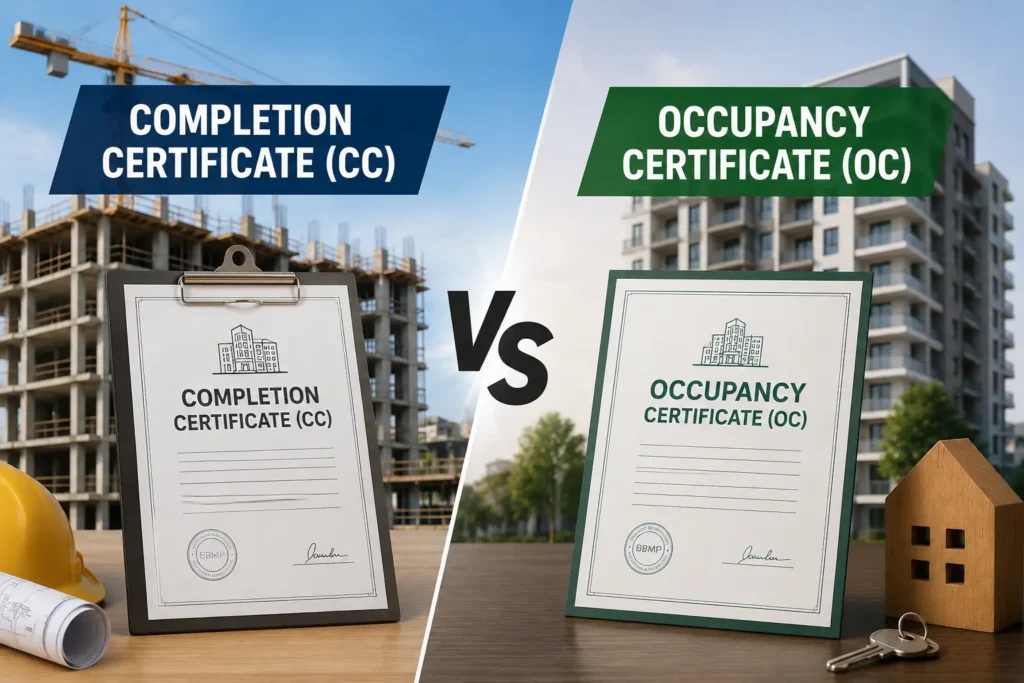
Completion Certificate (CC)
Issued by BBMP or BDA after verifying that construction is complete and matches the approved building plan. It confirms the building is built — not that it is safe or legal to live in.
Occupancy Certificate (OC)
Issued after the CC, only once all utility approvals, fire NOC, structural stability certificate, and inspection sign-offs are in place. It confirms the building is fit for habitation.
Important: If your builder hands you a CC when you ask for OC, ask specifically: “Has the Occupancy Certificate been issued separately? Can I see it?” They are not the same document.
OC and CC are only two parts of the documentation picture. Khata serves a different purpose, so it is important to understand how all three documents differ before buying a flat in Bangalore. Read our complete guide to OC vs Khata vs Completion Certificate in Bangalore.
The sequence is always CC first, then OC. A builder handing you possession without an OC even with a CC in hand is technically violating RERA Karnataka regulations. Under Section 11(4)(b) of the Real Estate (Regulation and Development) Act 2016, builders are legally required to obtain OC before offering possession to any buyer.
Source: RERA Act — Ministry of Housing
If you’re currently comparing ready-to-move vs under-construction options, read our guide on Ready-to-Move vs Under-Construction Homes in Bangalore to see how OC status affects your choice.
Why Does the Occupancy Certificate Matter for Flat Buyers in Bangalore?

Here’s what most buyers don’t realise until it’s too late.
1. Living without OC is illegal
Under the Karnataka Municipal Corporations Act and BBMP bye-laws, occupying a building without OC is a violation of municipal law. The corporation can issue eviction notices or impose penalties. The fact that many people have done it without consequence doesn’t mean the risk doesn’t exist it means it’s been deferred.
2. You won’t get a Khata transfer
BBMP will not issue an A Khata for your apartment if the building lacks a valid occupancy certificate in Bangalore. Without Khata, you cannot pay property tax in your name, register the property for resale, or secure a mortgage.
3. Banks can reject your home loan
Most banks and housing finance companies require an OC before releasing the final disbursement of a home loan. For resale properties, the new buyer’s lender will verify OC before approving a loan. A flat without OC has reduced loan eligibility and resale appeal.
4. Utility connections are at risk
Water, electricity, and sewage connections can be disconnected or denied to buildings that don’t hold a valid OC. In the event of any accident or structural failure in a building without OC, residents may not be eligible for insurance compensation.
5. Resale becomes complicated
A flat without OC sells at a discount — if it sells at all. Future buyers will ask, their banks will ask, and their lawyers will flag it immediately. This is not a future problem it becomes your problem the day you try to sell.
If you’re evaluating a property, our Complete Checklist Before Buying an Apartment in Bangalore 2026 has OC verification as one of its key steps.
What Is the New GBA OC Rule Change in Bangalore 2026?

In September 2025, the Karnataka Cabinet announced a significant update. Residential buildings on plots of 1,200 sq ft and above within the Greater Bengaluru Authority (GBA) limits will no longer be required to obtain a mandatory OC. This was extended under Section 241(7) of the GBA Act, 2024, primarily in response to thousands of completed homes being denied electricity connections due to missing OCs.
Source: 99acres — Bangalore OC Update, October 2025
For homeowners in buildings already completed but stuck in OC limbo, this brings relief faster access to electricity, water, and Khata.
However, experts caution that this exemption does not apply to B Khata properties. Developers of multi-storey buildings above the threshold still need to complete the full compliance process. Industry observers warn that removing OC requirements without equally rigorous replacements could allow builders to cut corners on safety.
If you’re buying a new apartment in Bangalore in 2026, always verify whether the OC exemption applies to your specific project or if full OC compliance is required. When in doubt, ask for it in writing.
How Do I Check OC Status Online in Bangalore?
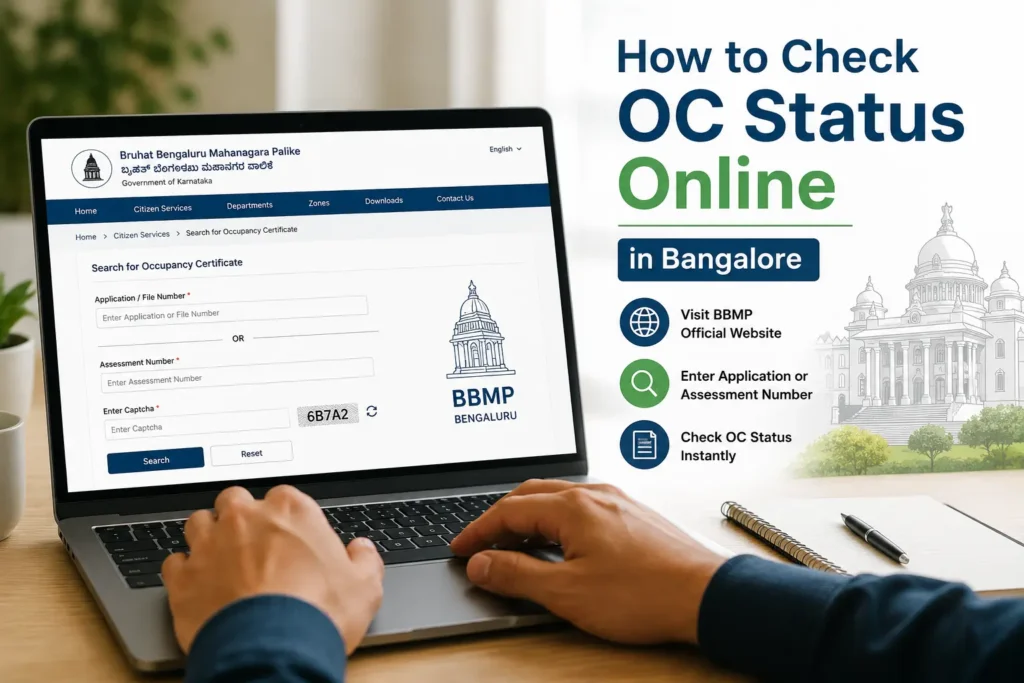
You don’t have to rely on your builder’s word. The BBMP OC status check is available online. Follow these steps:
- Visit the BBMP Town Planning portal: site.bbmp.gov.in click on Occupancy Certificate Details
- Select your zone and year, then click Submit
- Enter the application number or property details to track status
- For RERA-registered projects, cross-check on the KRERA portal at rera.karnataka.gov.in
BBMP portal: site.bbmp.gov.in/buildingplanoccupancy.html
Under BDA jurisdiction, the indicative OC processing timeline is 12 working days under the Sakala framework. If your builder says OC is “applied for” and more than 30 working days have passed with no update, that is a signal to escalate immediately.
What Should I Do If My Builder Is Delaying the OC?
This is the situation nobody wants to be in — you’ve moved in, or you’re about to, and the builder says the OC is “pending” or “on the way.” Here’s what you can actually do:
- Step 1: Get it in writing. Ask the builder for a written commitment on when the OC will be delivered. If they refuse, that tells you something.
- Step 2: Include OC as a condition in your sale agreement. If you haven’t signed yet, make OC delivery a contractual condition before final payment.
- Step 3: File a KRERA complaint. Karnataka RERA allows buyers to file complaints against builders who violate OC obligations. RERA can direct the builder to comply and award compensation for delays.
- Step 4: Send a legal notice. A formal legal notice to the builder puts pressure and creates a paper trail if you need to escalate further.
- Step 5: Approach the consumer court. Failure to provide OC qualifies as a deficiency of service under consumer law. File a complaint with the District Consumer Disputes Redressal Commission.
Choosing a builder with a consistent track record of legal compliance matters enormously. Read our guide on How to Check a Builder’s Reputation in Bangalore Before Booking before signing anything.
Final Word
The occupancy certificate in Bangalore is not a formality. It is the difference between a legally owned home and an unauthorised structure that can create financial, legal, and safety problems for years.
Before you sign, before you pay the final instalment, before you move in — ask for the OC. If the builder hesitates, that hesitation is your answer.
If you want to buy a home in Bangalore where legal compliance is already verified, start with Buloke’s curated residential projects. We do the due diligence so you don’t have to.
FAQ
Can I move into my flat without an occupancy certificate in Bangalore?
No. Moving into a flat without OC is technically illegal under the Karnataka Municipal Corporations Act and BBMP bye-laws. The municipality can issue notices, impose penalties, or in extreme cases disconnect utilities. The possession letter from your builder is not a substitute for OC.
What is the difference between OC and CC in Bangalore?
A Completion Certificate (CC) confirms that construction is finished and matches the approved plan. An Occupancy Certificate (OC) confirms the building is legally safe and cleared for occupation. OC comes after CC. You need both, but OC is what gives you the legal right to live there.
Who is responsible for getting the OC the builder or the buyer?
The builder. Under RERA, the developer is legally obligated to obtain OC before offering possession. Buyers cannot apply for OC on their own because the application requires technical documents only the builder holds. Buyers must insist on receiving a copy of the OC before making final payment or taking possession.
What if my builder refuses to give me the OC?
You can file a complaint with Karnataka RERA, send a formal legal notice to the builder, file a consumer complaint for deficiency of service, or approach a civil court. Document all communication in writing before escalating.
Is OC mandatory for a home loan in Bangalore?
Yes, for most lenders. Banks and housing finance companies require a valid occupancy certificate before releasing the final disbursement of a home loan. For resale properties, the buyer’s lender will also verify OC before approving a new loan on the flat.
How do I check BBMP OC status online?
Visit site.bbmp.gov.in, go to the Occupancy Certificate Details section, enter your zone and application details, and track the status. For RERA-registered projects, you can also check on the KRERA portal at rera.karnataka.gov.in.
Does the 2026 GBA OC exemption mean I don't need to check OC anymore?
Not entirely. The GBA exemption applies to specific residential plot sizes within GBA limits and does not cover all buildings or jurisdictions. B Khata properties are excluded. Multi-storey apartment complexes may still require full OC compliance. Always verify the applicable rule for your specific project.
